01
Sacred authenticity
Support prayer, contemplation, learning and awakening through a legible hierarchy of sacred spaces.
Vision
Dewachen is envisioned as a world-class sanctuary for contemplative living, Dharma learning, retreat and awakening: rooted in Bhutan's Buddhist heritage and open to the world.
Meaning
Amitabha, meaning Infinite Light, is associated with Sukhavati: the Western Pure Land, known in Bhutan as Dewachen Zhingkham. It represents a condition in which environment, consciousness and spiritual practice are oriented towards awakening.
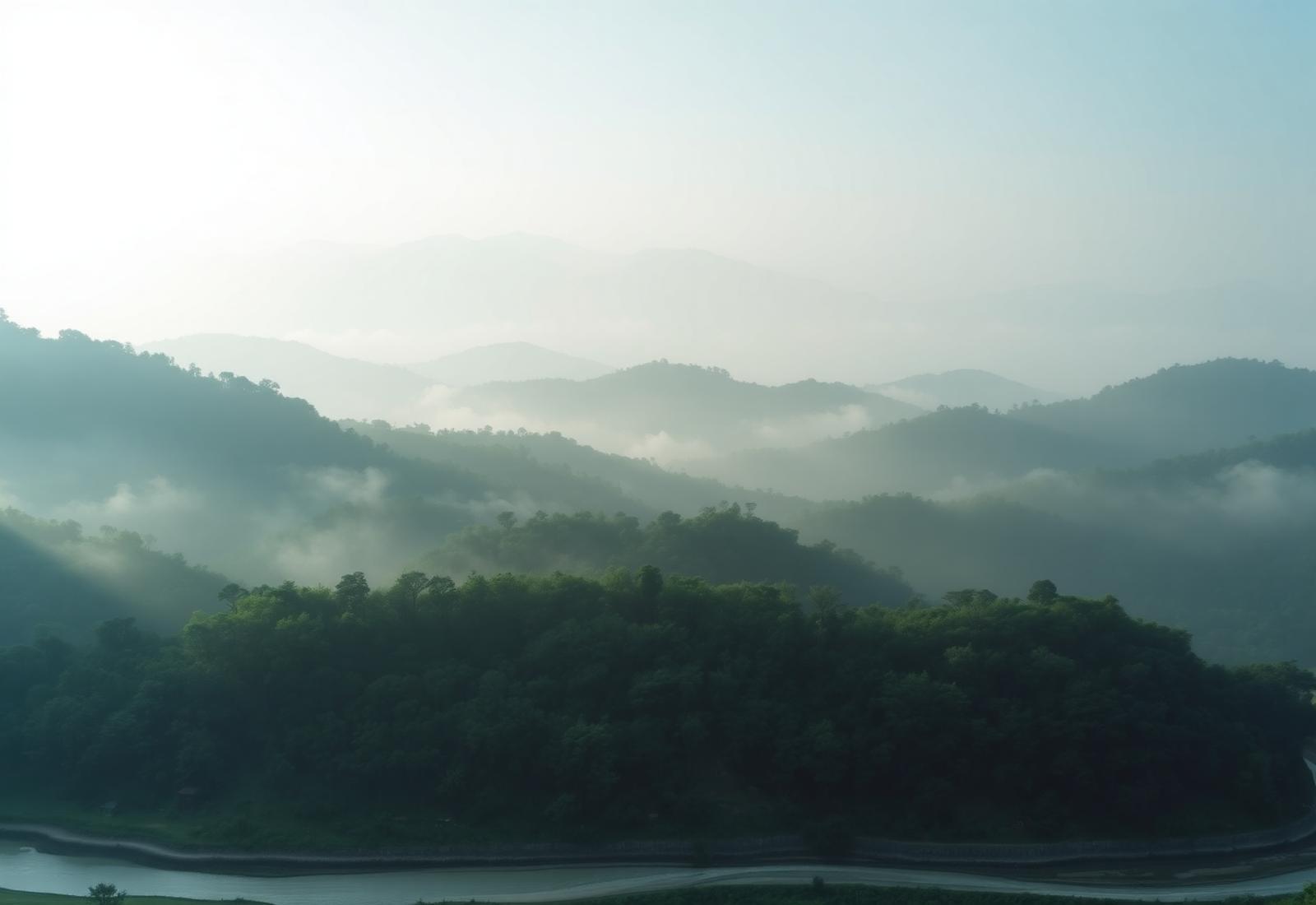
The project does not seek to reproduce a literal or historic image of that realm. It translates its qualities of purity, compassion, wisdom and tranquillity into a contemporary language of landscape, architecture and human experience.
Guidance
The project is being developed under the spiritual guidance of the Tsuglag Lopen of the Central Monastic Body of Bhutan.
An approved statement from the Tsuglag Lopen will appear here.
Within GMC
Gelephu Mindfulness City is a proposition that human wellbeing, economic activity and the natural environment belong within one model of development. Dewachen will make that spiritual dimension tangible through place, practice and community.
As a non-commercial anchor of contemplative depth, the Centre can ground the future city in Bhutanese Buddhist legitimacy while welcoming devotees, residents, pilgrims and international learning communities.
Gross National Happiness
Gross National Happiness recognises that wellbeing depends upon relationships among the individual, society, the natural environment and institutions. Dewachen carries that understanding into a physical setting for social cohesion, cultural continuity and psychological wellbeing.
Inheritance
Bhutan's Buddhism is a living tradition carried in monasteries, teachers, ritual, sacred arts and community life. Dewachen will draw from this inheritance with care and continue it into the future.
Contribution
The Centre can become an international destination for Buddhist practice and learning, cultural exchange and sustainable spiritual tourism. Its value rests in an authentic encounter with Bhutan's living tradition rather than a generic wellness experience.
Guiding principles
01
Support prayer, contemplation, learning and awakening through a legible hierarchy of sacred spaces.
02
Carry Buddhist tradition, craftsmanship and cultural memory forward without reproducing a historic image literally.
03
Translate the Pure Land ideal into architecture of its own time, with clarity, restraint and lasting material quality.
04
Use water, vegetation, light, silence, thresholds and framed views to support inward attention.
05
Provide dignified access for devotees, practitioners, elders, residents, visitors and people of all abilities.
06
Build ecological resilience, operational clarity and durable institutions into the Centre from the beginning.